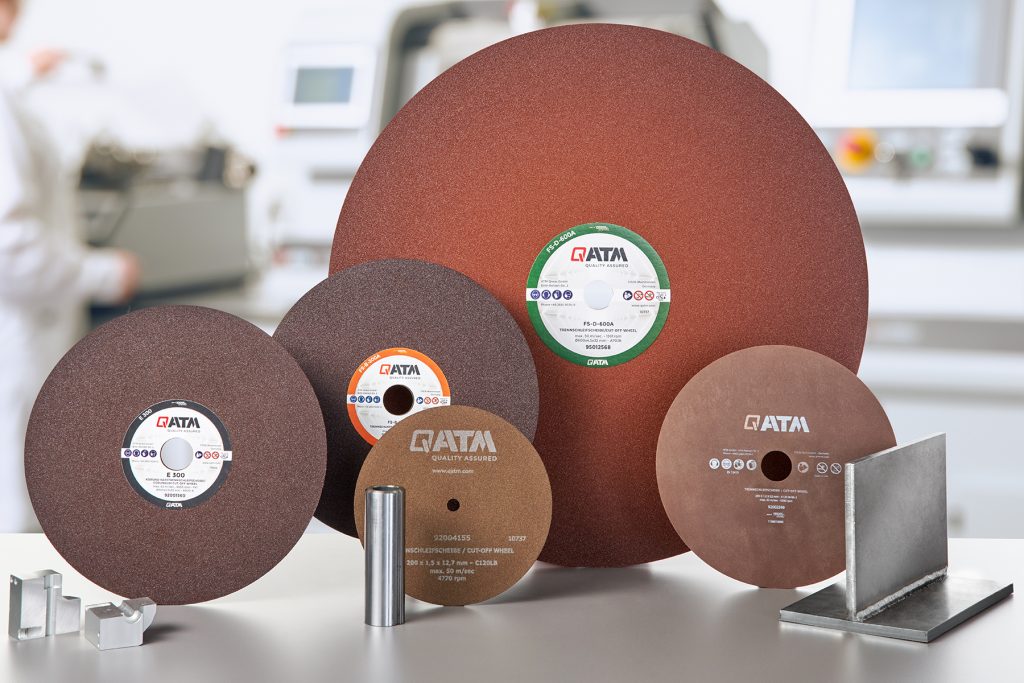

The process of cutting, specifically wet abrasive cutting, is essential for materialographic sectioning of samples. In this process, cut-off wheels of different material thicknesses, abrasive particles and bonds are used on a corresponding wet abrasive cutting machine. These bond types can be synthetic resin, rubber, or metal. For the abrasives, aluminum oxide, silicon carbide, diamond or CBN is used. These abrasive particles are enclosed in a bond matrix.
Benefits
Recommended applications
Precision cutting enables cutting directly next to significant analysis areas and also for materials with particularly complex material properties. Precision cut-off wheels are significantly thinner than larger diameter cut-off wheels. With QPREP, you can choose from aluminum oxide, silicon carbide, diamond or CBN abrasives. The abrasives can be either electroplated, resin bonded, rubber bonded or bronze bonded. QPREP precision cut-off wheels are the ideal solution for cutting requirements with high surface quality and exact cutting accuracy.
Benefits
Recommended applications
Significant properties for cut-off wheels are wear (i.e., abrasion resistance), long lifetime and cutting performance. Characteristics of the wheel composition are the abrasive used (aluminum oxide, silicon carbide, diamond, cubic boron nitride (CBN) and the bond type (metal, resin or rubber). The goal of any cut is to separate the material with minimal deformation and temperature effect. For a clean cut, the abrasive particles and bond type of the cut-off wheel should be matched to the material being cut.
QPREP Premium cut-off wheels offer the optimal solution for a wide range of applications.
The color coding of the premium cut-off wheels enables quick, visual assignment and identification of the several types.
Cut-off wheel selection according to material hardness

Optimum cooling is essential during cutting. Excessive heat generation during the cutting process damages the specimen as well as the cutting wheel. QPREP coolant and anti-corrosion agent help to dissipate the heat and remove chips at the cutting point. A corrosion inhibitor must be added to the coolant, otherwise there is a risk of oxidation on the cut-off surface of the specimen as well as on machine components.
Product Advantages
Recommended applications
During cutting, various residual materials are produced from the specimen (chips) and from the cut-off wheel (wear/tear). To prevent these residual materials from entering the cooling water / waste water system or the pump mechanism, the use of filter systems is required. A suitable filter system with the correct mesh size, filter material and dimension has a significant influence on the cleanliness of the coolant.
Product Advantages
Recommended applications
The use of a filter system keeps the coolant significantly longer clean and prevents damage to the pump and machine.