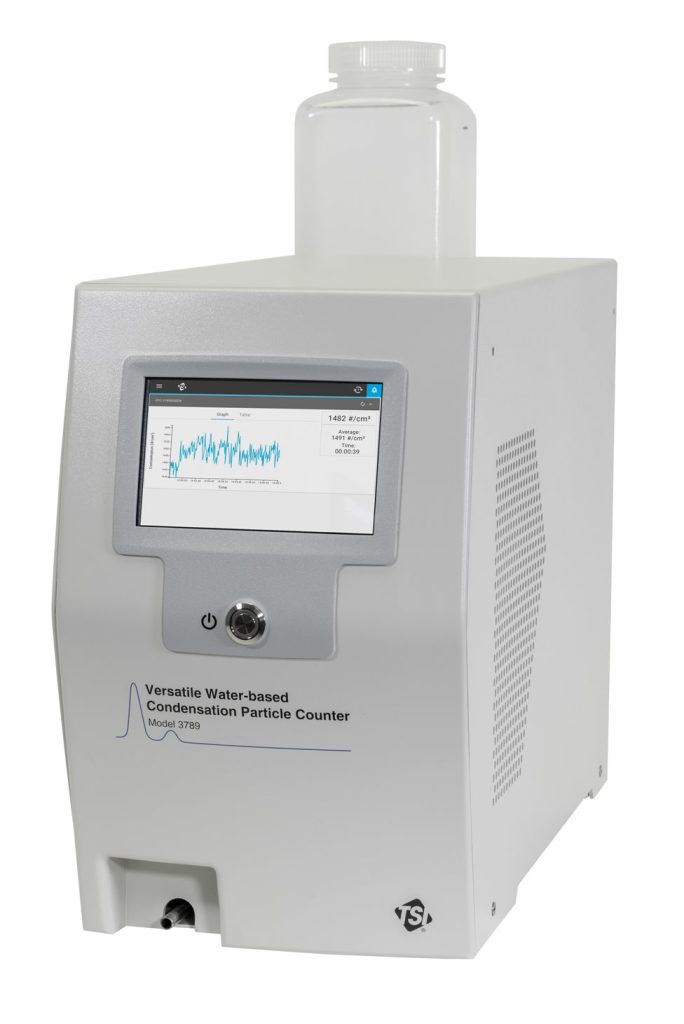
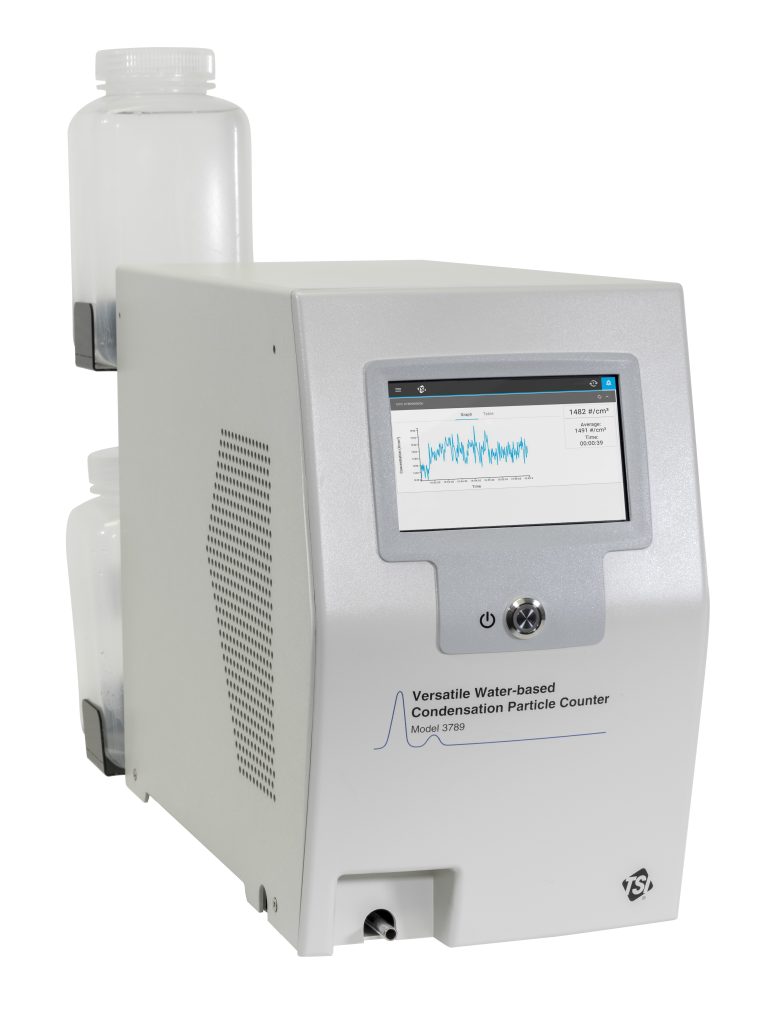


Water-Based Condensation Particle Counters (WCPCs) deliver accurate concentrations of particles in gases while making use of safe, eco-friendly and easily available distilled water. When combined with a particle sizer, nanoparticle size distributions and concentration can be quantified from <2 nm to nearly 1,000 nm.
The 3rd generation of WCPC comes with numerous enhancements:
+ Unprecedented reliability
+ Low maintenance
+ Selectable cut-off particle size
Our customers rely on constant operation of the Versatile Water-Based Condensation Particle Counter (VWCPC) under many different conditions. The 3rd generation of WCPC from TSI is robust by design.
Micro-pumps control the water injection into the wick and the ejection of excess water from the wick. Controlling both of these flows prevents the accumulation of excess water inside the instrument, even in the case of a blocked inlet.
The condensation process has been extended by a 3rd step. Following the inlet:
All three stages are connected by a single newly designed wick which serves as the water reservoir.
These features make the new VWCPC very resistant to pressure changes occurring in some experimental setups. The following stress test shows that the 3789 recovers rapidly from extreme and frequent pressure fluctuations, returning quickly to making accurate measurements. In the test, the CPC inlet was temporarily blocked over 1,000 times, simulating extreme pressure fluctuations. The concentration readings dropped during the blockage of the sampling flow as expected. After the blockage was removed, the concentrations recovered quickly to the same level as the undisturbed reference CPC.
While the wick serves as the water reservoir, a stagnant reservoir can quickly become contaminated with microbial growth. This degrades the wick and compromises data quality. To resolve this problem, the design of the 3789 uses a slight amount of excess water to flush the wick. This regenerates the wick material and extends the wick life-time to 6 months of operation time and beyond.
New to Condensation Particle Counter technology is the ability of this VWCPC 3789 to enable the user to easily vary the counting efficiency of the instrument. The user interface provides the choice of setting the 50% counting efficiency to 2.2 nm, 7 nm, or to a custom setting. The pre-defined efficiency setpoints are valid for sucrose and characterized at TSI.
For the first time, the skilled researcher can choose different setpoints to vary the cut-off particle size, even outside the settings predefined by the manufacturer. With appropriate instrumentation, it is possible to detect particle sizes near 1 nm.*
* Source: Susanne V. Hering, Gregory S. Lewis, Steven R. Spielman, Arantzazu Eiguren-Fernandez, Nathan M. Kreisberg, Chongai Kuang & Michel Attoui (2017) Detection near 1-nm with a laminar-flow, water-based condensation particle counter, Aerosol Science and Technology, 51:3, 354-362.
TSI’s Versatile WCPC is suitable for most particle counting applications, but its ability to detect down to 2.2 nanometers make this Water-based CPC ideally suited for: