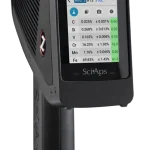

Every element in the periodic table, in seconds, in a handheld.

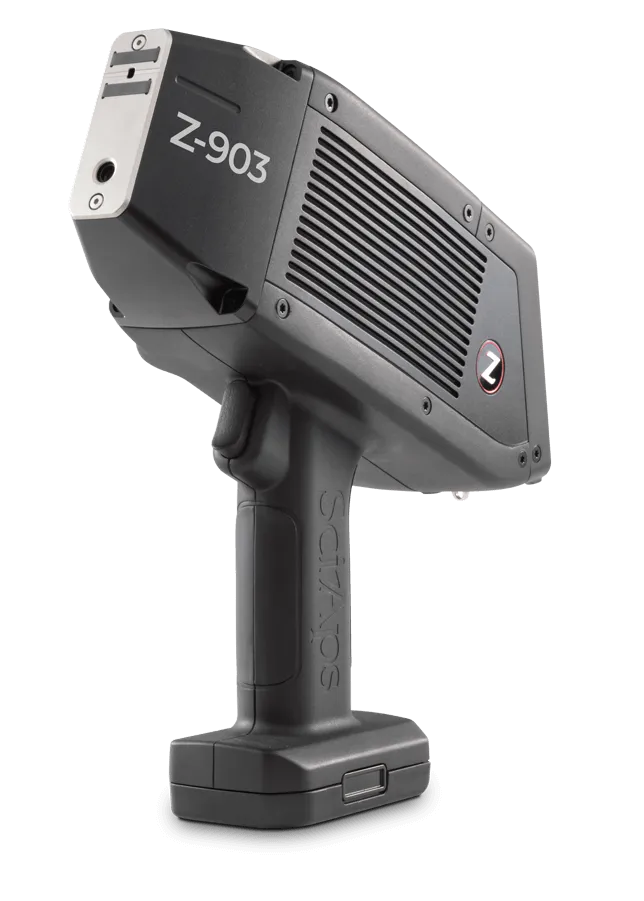
The Z-903 accomplishes what no other portable analyzer has done. It’s a handheld analyzer that measures every element in the periodic table of the elements – from H to U.
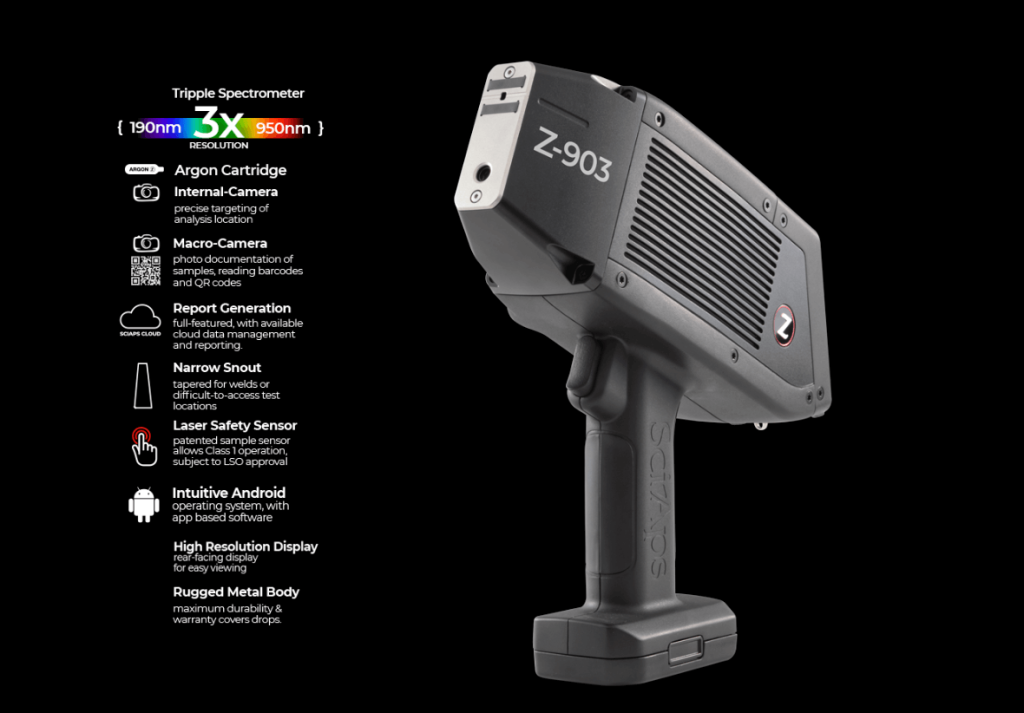
It uses the same powerful laser as SciAps other Z-900 models, but with an extended spectrometer range from 190 nm out to 950 nm.
The Z-903 is most widely used for mineral exploration including lithium in both hard rock and brines. It is also used in forensics, authentication, archeology and oil/gas exploration due to the wide elemental range.
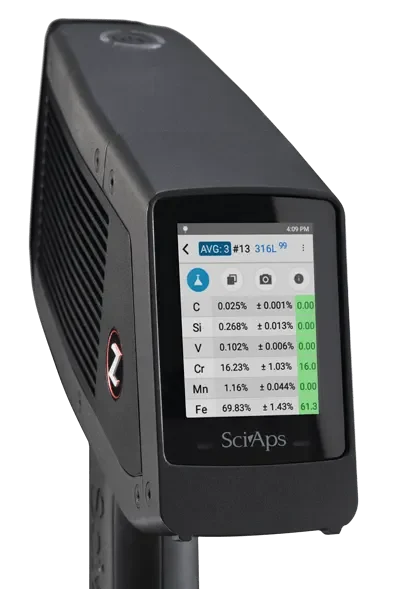
The laser strike pattern, cleaning shots, spectrometer settings are all under user control. The analyzer includes advanced software for modifying all settings, comparing spectral data, and for generating quantitative calibration curves. The Z-903 features the same Android OS and intuitive App-driven software as all other SciAps models.

| Specification | Details |
|---|---|
| Weight | 4.35 lbs. (1.97 kg) with battery |
| Processing Electronics | ARM Quad Cortex-A53 1.2GHz, 2 GB LPDDR3 memory, 16 GB eMMC |
| Dimensions | 10.75 × 2.875 × 8.625 inches |
| Data Storage | Results storage: 32 GB SD |
| Spectral Range | 190 nm – 950 nm |
| Display | 3.5-inch high-brightness color touchscreen, readable in all conditions. Rear-facing display for easy results viewing. |
| Drift Correction | On-board automated drift correction software with factory or user-provided reference materials. |
| Sample Viewing | Integrated camera and laser target indicator before and during analysis provide proper sample alignment. Includes second macro camera for scanning QR/barcodes, photo documentation, and report generation. |
| Power | On-board rechargeable Li-ion battery, rechargeable inside device or with external charger, AC power. |
| Regulatory | CE, RoHS, USFDA registered. Class 3b laser. Sample sensor allows operation under Class 1 conditions subject to local LSO approval. |
| Laser Raster | On-board Y stage for rastering laser to discrete locations for targeted analysis or averaging. |
| Connectivity | Built on Google Android platform for real-time data exporting, including WiFi (IEEE 802.11b/g/n), Bluetooth (BR/EDR+BLE), GPS, and USB-C connectivity. |
| Security | Password protected with multi-user support and configurable access. |
| Atmosphere | SciAps proprietary Opti-Purge inert argon environment improves spectral signal-to-noise ratio and UV range performance. |
| Calibration Check | Internal 316 stainless check standard for calibration verification and wavelength scale validation. |
| Grade Library | 500+ grades, multi-library support, libraries may be added or edited. |
| Analytical Range | One or more spectral lines from all elements in the periodic table. |
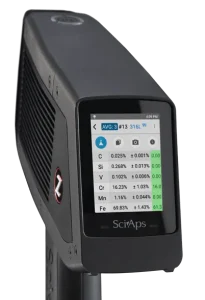
The key to rock solid, in-field carbon analysis for alloys.
Identification of stainless steels and low alloy steels, including carbon analysis down to 70 ppm and instant CE (carbon equivalents) calculations.
Powerful laser, on-board argon purge and high resolution spectrometer are built for carbon.
Narrow profile for accessing the tightest spaces, aerospace-grade aluminum body for improved performance in high ambient temperatures, and re-designed user-interface. The most usable platform on the market, at only 4.35 lbs. (1.97 kg).
Spectrometer range 190 nm – 625 nm. Includes a third, dedicated spectrometer for superior resolution.
PMI and NDT
Confirm alloy type and grade 300 series stainless steels into L, H, and S series. Carbon equivalent for welding. Material verification pre- and post-fabrication. Validating mill test reports. Material verification in chemical plants and refineries. Re-rating vessels.
Pipeline integrity management
Grading. Determining carbon equivalents. Validating MTRs.
Steel production
Screen incoming scrap material. In-process quality control. Resolving material mix-ups. Rapid screening of material at EAF for heat compliance.
Argon purge is essential for quantitative analysis with LIBS and OES, and for carbon it’s critical. SciAps patented Opti-Purge technique is a key component for measuring carbon accurately. Opti-Purge delivers argon exactly where it’s needed and uses about 1,000 times less argon than a spark OES, allowing for a user-replaceable canister. Operators can analyze up to 600 samples with the argon canister for most alloy testing, and 125-200 samples for carbon analysis.
Multi-shot averaging and data rejection are critical to getting the best carbon tests. The combination of these two features, known as analysis averaging, allows the operator to (optionally) reject test data with significant point-by-point discrepancies then automatically create a final result.
The SciAps laser delivers 5-6 mJ/pulse on the sample, with a 50 Hz repetition rate. As any user of spark OES knows, sample prep is critical for carbon analysis—a good grind and a good pre-burn are as critical for LIBS as for spark OES. SciAps high energy and high rep rate laser (50 Hz) rapidly burns off surface contamination in order to provide a good analysis.
Proper alignment is critical to getting good analysis. Take out the guess work with SciAps micro-camera and LED Spotlight. The camera shows the sample in high resolution and ensures that the instrument is positioned correctly; LED Spotlight shows exactly where the laser will burn the sample. Get a good burn every time.
Rastering is critical for accurate carbon tests with LIBS. The Z moves the laser to 6 distinct locations and analyzes each spot for 0.5 seconds for every 3-second test. The laser is typically 50 um diameter beam. On that scale, micro inclusions in the alloys and the grain structure of the alloy can impact the analysis. By averaging across six unique locations, the system collects data that is representative of the alloy, not just an individual location.
Argon costs just pennies per test, far less expensive than spark OES and much more convenient. What does that mean in real terms? It depends if you are doing carbon tests or general alloy tests. You can expect to get about 100 tests per canister for carbon, and 600 tests for general alloy; if you buy your argon canisters in the 10 pack, it will cost you $65 ($6.50 each), which means 6 cents, or 1 cent per test, respectively. Don’t always need carbon? Then add on the SciAps “Dual Burn” capability for non-carbon tests in air.
| Specification | Details |
|---|---|
| Weight | 4.35 lbs. (1.97 kg) with battery |
| Processing Electronics | ARM Quad Cortex-A53 1.2GHz, 2 GB LPDDR3 memory, 16 GB eMMC |
| Dimensions | 10.75 × 2.875 × 8.625 inches |
| Data Storage | Results storage: 32 GB SD |
| Spectral Range | 190 nm – 625 nm |
| Display | 3.5-inch high-brightness color touchscreen, readable in all conditions. Rear-facing display for easy results viewing. |
| Drift Correction | On-board automated drift correction software with factory or user-provided reference materials. |
| Sample Viewing | Integrated camera and laser target indicator before and during analysis provide proper sample alignment. Includes second macro camera for QR/barcode scanning, photo documentation, and report generation. |
| Power | On-board rechargeable Li-ion battery, rechargeable inside device or with external charger, AC power. |
| Regulatory | CE, RoHS, USFDA registered. Class 3b laser. Sample sensor allows operation under Class 1 conditions subject to local LSO approval. |
| Laser Raster | On-board Y stage for rastering laser to discrete locations for targeted analysis or averaging. |
| Connectivity | Built on Google Android platform for real-time data exporting, including WiFi (IEEE 802.11b/g/n), Bluetooth (BR/EDR+BLE), GPS, and USB-C connectivity. |
| Security | Password protected with multi-user support and configurable access. |
| Atmosphere | SciAps proprietary Opti-Purge inert argon environment improves spectral signal-to-noise ratio and UV range performance. |
| Calibration Check | Internal 316 stainless check standard for calibration verification and wavelength scale validation. |
| Grade Library | 500+ grades, multi-library support, libraries may be added or edited. |
| Analytical Range | One or more spectral lines from all elements in the periodic table. |